
Nolyn
AI ecommerce research: connect market signals, review samples and advertising economics
Listing details
HiCyou directory record
- Listed website
- nolyn.ai
- Directory record created
- Nov 2, 2026
- Last record update
- Nov 2, 2026
Listing information
- Overview
- 4 key features
- 3 use cases
This page describes HiCyou's directory record. It is not a security, ownership, or product-quality certification.
Review the external site before sharing sensitive information or making a purchase.
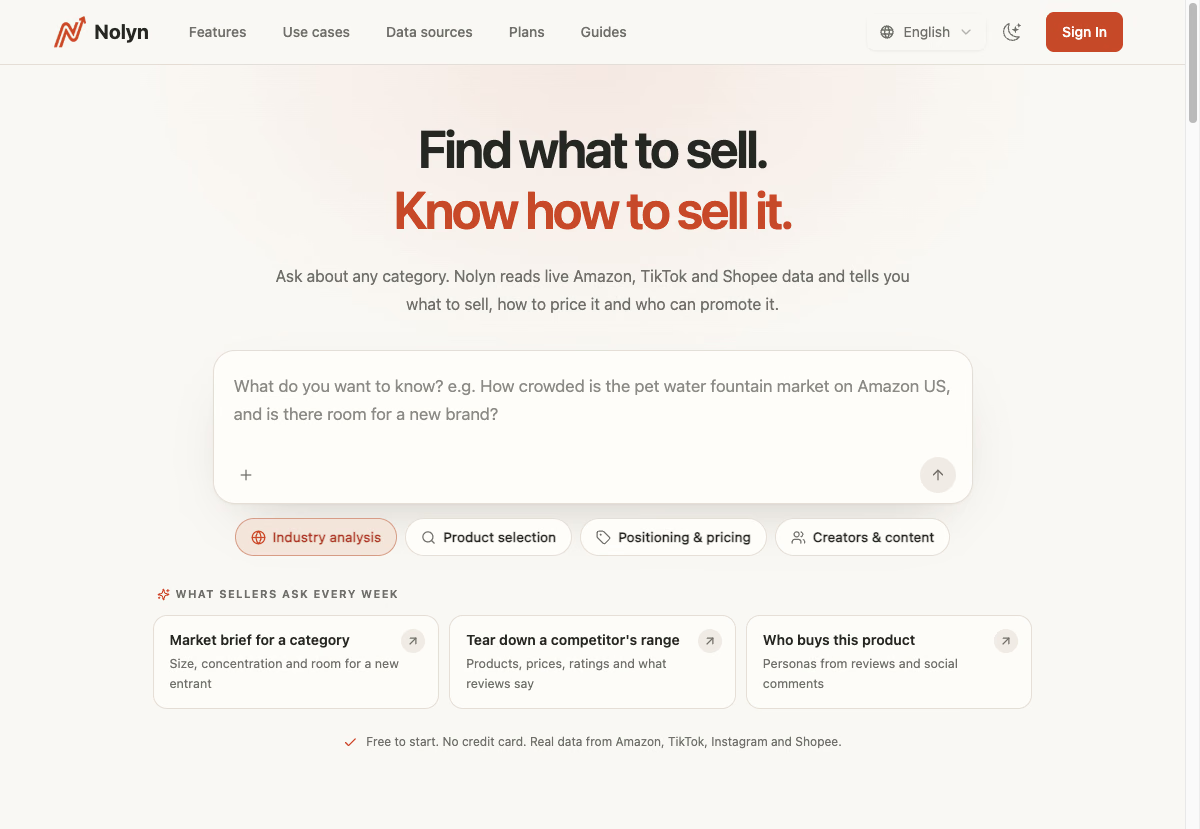
What is Nolyn
A product opportunity needs more than a bestseller rank. Nolyn helps ecommerce teams ask a specific question, gather supported Amazon, TikTok Shop or Shopee signals, and turn the findings into a research brief. Customer review samples can reveal recurring complaints, while scheduled follow-up helps revisit assumptions.
Start with market context, inspect buyer feedback, then test unit economics. The free ROAS calculator at https://www.nolyn.ai/tools/roas-calculator helps compare ad revenue with spend and margin assumptions. ROAS alone is not proof of profit. For sampled feedback, see https://www.nolyn.ai/tools/amazon-review-analysis .
Our example at https://www.nolyn.ai/case-studies/tiktok-shop-best-sellers examines 450 listings across 16 US product types. Cumulative units are not monthly sales; sampled reviews are not all buyer opinions. These distinctions help readers avoid overconfident sourcing decisions.
Public calculators are free without login. AI research requires an account and credits, with 100 one-time introductory credits and Pro from $49/month. Submitted by the Nolyn team.
Key Features
Use Cases
- Compare product-market signals before sourcing
- Identify recurring complaints in sampled reviews
- Test advertising break-even assumptions
Why do startups need this tool?
Small ecommerce teams can use a repeatable research brief before committing to sourcing or ad tests. Keep the question narrow, record sample and time-period limits, and check the margin assumptions behind a seemingly attractive product.